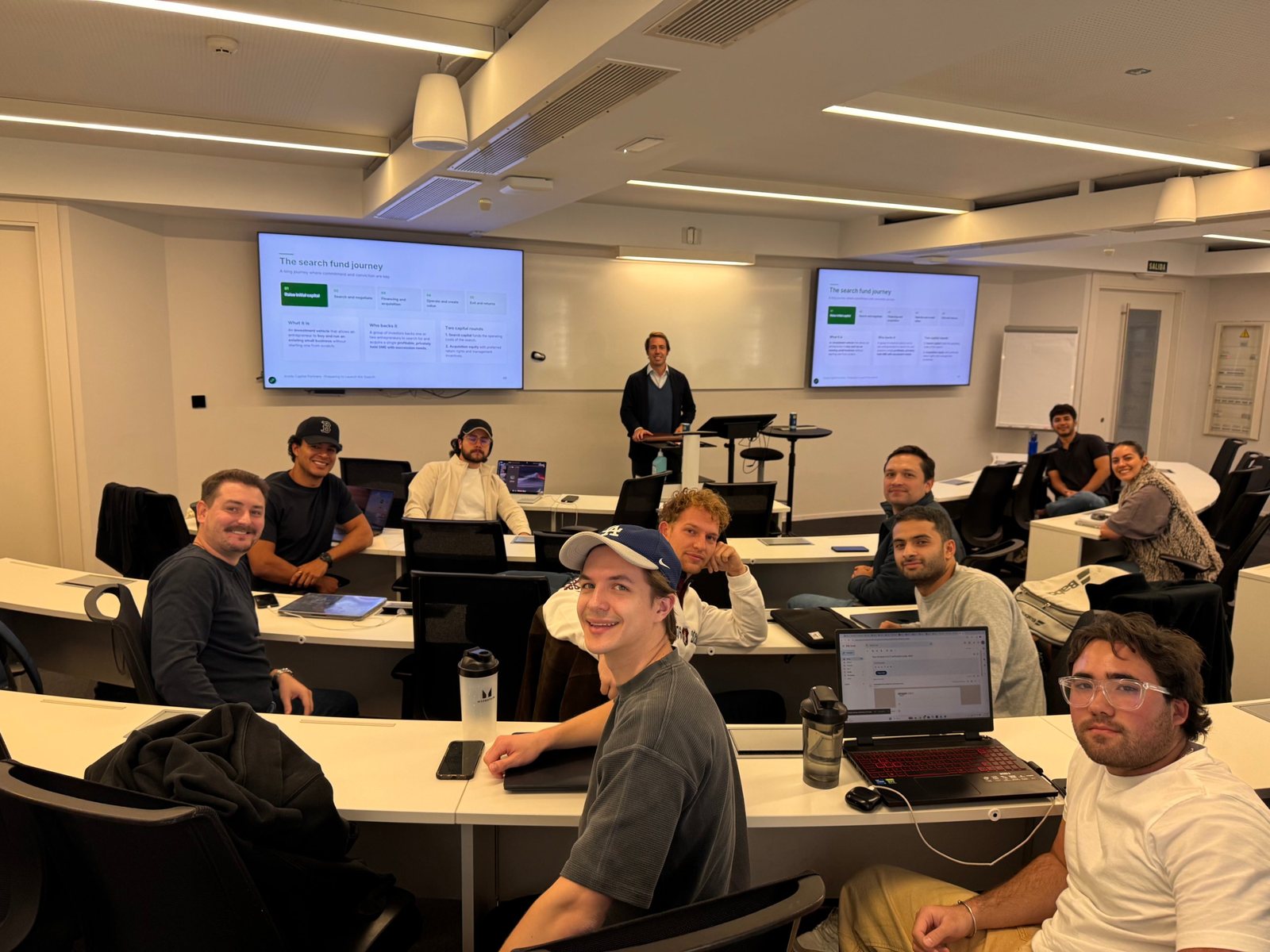
We joined aspiring entrepreneurs to discuss how to prepare for their search, approach fundraising and assess different value creation strategies — from traditional search funds to buy-and-build and long-term ownership.
Javier Puig of Arada Capital Partners recently delivered a session at IE Business School focused on preparing to launch a search fund. Titled “Preparing to Launch the Search: Building Your Fundraising Toolkit,” the session offered a practical perspective on the decisions entrepreneurs face before embarking on this journey: how to develop their investment proposition, build an investor base and structure their fundraising process.
We were delighted to take part and help participants prepare for their entrepreneurial journeys. Sharing our experience with people considering acquiring and leading a business is also an opportunity to contribute to a more knowledgeable, connected and resilient entrepreneurship-through-acquisition ecosystem.
Search funds: entrepreneurship through acquisition
A search fund offers an alternative to starting a company from scratch. In the traditional model, one or two entrepreneurs secure backing from a group of investors to identify, acquire and lead an existing business. The financing typically takes place in two stages: an initial round to fund the search, followed by a second round to finance the acquisition of the selected company.
The ambition extends beyond finding a business for sale. It involves identifying the right company, building trust with its owners and developing a credible plan for continuity and growth under new leadership.
During the session, we also discussed the evolution of the model. Alongside traditional search funds, different funding approaches, investment structures and value creation strategies have emerged. This diversity creates more options for entrepreneurs and investors, while making it increasingly important to understand the capabilities, commitments and time horizons each approach requires.
Preparing for fundraising: more than building a pitch deck
One of the session’s central messages was that fundraising begins well before the first formal investor meeting. Conversations with current and former searchers, business owners and investors help entrepreneurs test their expectations, understand the challenges ahead and start building trusted relationships. Preparing thoughtfully, listening carefully and following up professionally are all part of that process.
We explored four essential building blocks:
A coherent investment proposition. Entrepreneurs need to explain why they are pursuing this path, how their experience prepares them for it and how they intend to conduct their search. For partnerships, demonstrating complementary skills and a strong working relationship is equally important.
Well-prepared fundraising materials. The pitch deck and private placement memorandum, or PPM, should clearly present the strategy, investment terms, budget, use of proceeds, risks and target sectors.
A considered investor outreach strategy. Local investors can provide market knowledge and networks, while helping build confidence among international investors. The right sequence should reflect each entrepreneur’s relationships and circumstances.
A disciplined closing process. Converting interest into commitments requires consistent follow-up and clear communication. A round is not closed when investors express their support: legal documentation must be completed, and funds received and reconciled.
The objective is not simply to complete a funding round. It is to build a group of partners who can support the entrepreneur through the search, acquisition and operating phases. Choosing investors therefore means considering not only their capital, but also their experience, availability and alignment with the project.
Buy-and-build: acquiring a business to build a broader platform
We also shared our perspective on strategies in which we are investing and opportunities we are evaluating, including buy-and-build.
This approach starts with the acquisition of a platform company, followed by acquisitions of complementary businesses. In fragmented markets, it can help expand geographic reach, broaden the service offering, add capabilities and achieve economies of scale. The aim is not simply to assemble a collection of companies, but to build a stronger business with greater capabilities and a more competitive market position.
Execution makes the difference. An acquisition strategy requires clear criteria for what to buy, how to finance it and how to integrate each business. It also needs the management team and systems to support expansion without undermining the original company. Success depends not just on completing transactions, but on translating them into tangible operational and commercial improvements.
For entrepreneurs, this distinction matters: acquiring and running a company and building an acquisition-led platform are related, but different, challenges.
Long-term holds: creating value over a longer horizon
Another topic we explored was long-term holds: investment approaches built around extended ownership periods.
These strategies give businesses more time to develop, with less pressure to sell within a predetermined timeframe. Where business quality and reinvestment opportunities justify it, a longer ownership horizon can support growth, operational transformation and the integration of acquisitions.
Holding a business for longer does not mean relaxing investment discipline. It requires continued assessment of the company’s performance and whether remaining an owner is still the right decision. It also makes alignment between entrepreneurs and investors particularly important, especially regarding the investment horizon and liquidity expectations.
The two approaches can complement each other, but they address different questions: buy-and-build describes how a business grows through acquisitions, while long-term ownership describes the horizon over which the investment is held and developed. A company can combine both when supported by the right capital, team and structure.
Supporting entrepreneurs from the outset
At Arada Capital Partners, we believe a strong investment begins well before an acquisition. It starts with a prepared entrepreneur, a coherent proposition and a relationship of trust among the people who will build the business together.
Launching a search fund is not only about raising capital and finding a company — it is about laying the foundations to lead that company, develop its potential and create lasting value.
We thank IE Business School for the invitation and all the participants for their engagement and thoughtful questions. It was a pleasure to contribute to the preparation of the next generation of entrepreneurs through acquisition.